Going to the grid: CFS applies to plug our first ARC fusion power plant into PJM

Commonwealth Fusion Systems (CFS) has pioneered another step of the journey to fusion energy, applying to connect our first ARC fusion power plant in Chesterfield County, Virginia to the world’s largest wholesale electricity market, PJM Interconnection.
Compared to other steps on the fusion commercialization path — developing our technology, raising our funds, building our supply chain — it might not be obvious why requesting a spot on the power grid is so important. So I’d like to explain what we did and why it’s a big deal.
When we submitted a Generation Interconnection Request last week with PJM, we became the first fusion power plant developer to take this definitive step with a major grid operator — pairing the breakthrough technology of fusion with real-world infrastructure to power our future. This is a bridge from the science phase of fusion energy to the real-world impact.
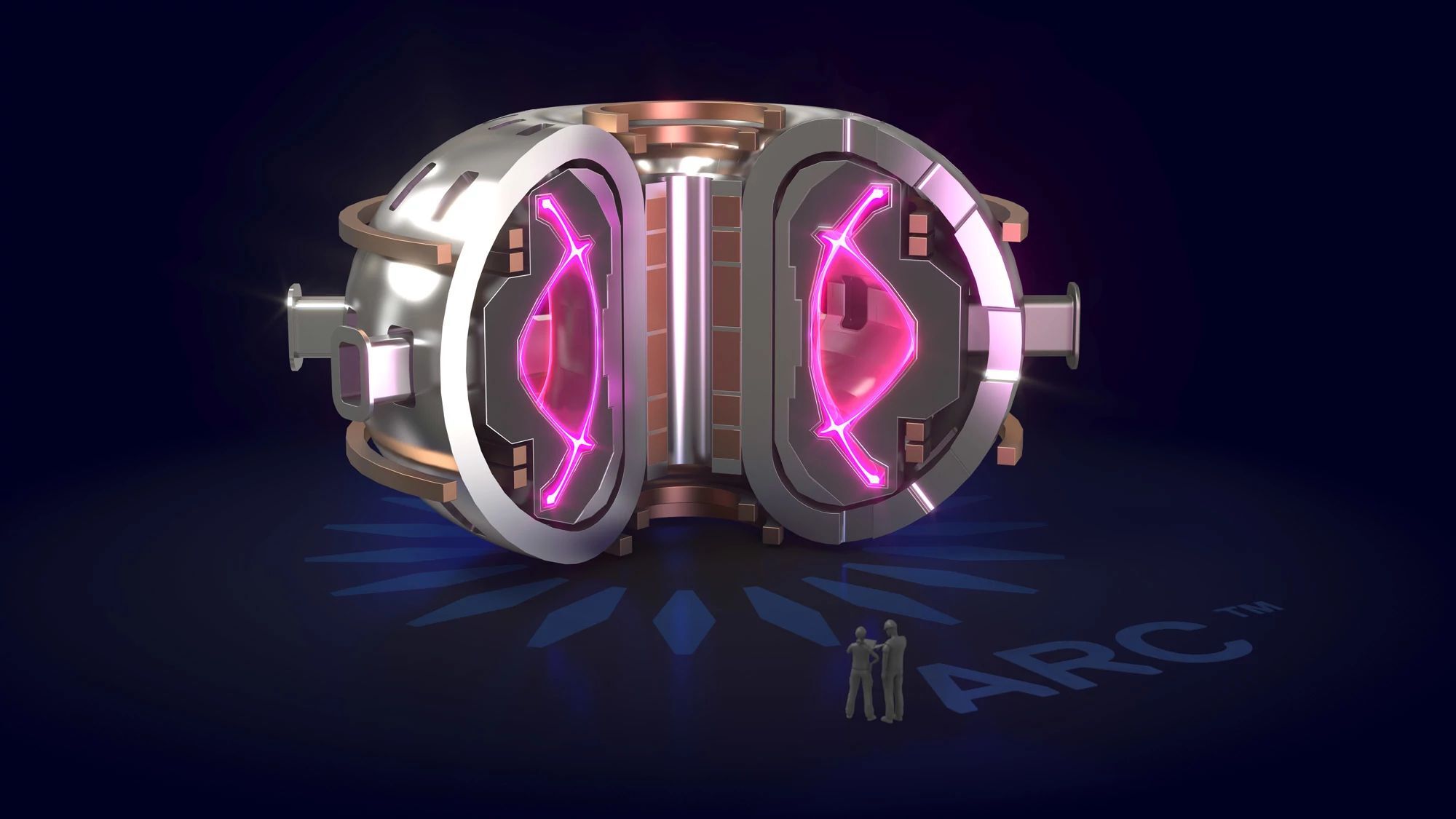
Although fusion energy on the grid is new, the path we’re taking to get it there isn’t. We’re applying for a home on the PJM system just like any other power plant must, and in many ways, our fusion power plant will look just like the 1,400 or so other interconnected generators already there. It’ll be just another source of electricity, except that instead of using the heat from burning coal or natural gas to boil water for a steam turbine, we’ll use the heat from the fusion process. That means our ARC plants can be the new building blocks for the grid, swapping in for older decommissioned coal or gas plants and arriving where demand is growing, capitalizing on the same grid infrastructure that exists today.
Clicking the “submit” button on the interconnection application was a big moment for CFS, for fusion energy, and for the Virginia site we’ve now named the Fall Line Fusion Power Station. This isn’t just about proving the science and physics anymore; it’s about proving that fusion can be deployed and connected.
We chose the Fall Line name because it signifies transition: Chesterfield County and Richmond sit directly on a geological boundary in Virginia called the Fall Line where the rocky, elevated Piedmont region drops down into the flat, sandy Tidewater coastal plain. This drop creates the rapids on the James River. Historically, Virginians built mills at the Fall Line to harness the kinetic energy of the falling water. With the Fall Line Fusion Power Station, we’ll harness a different form of energy — the clean, safe, secure power of fusion.
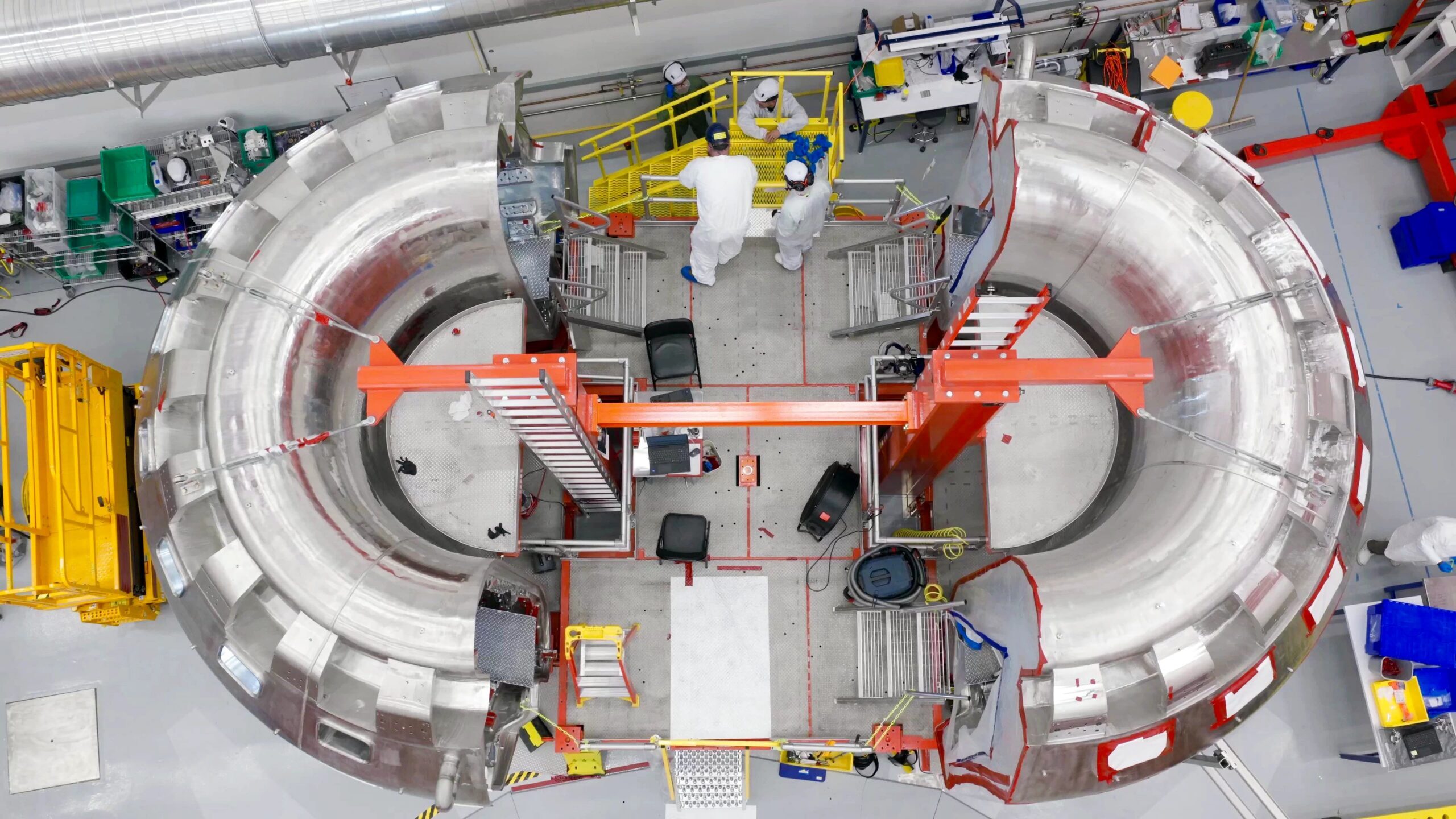
Fusion is the power of the sun and stars, and we’re bringing it to Earth. That requires new technology — in our case, a type of fusion machine called a tokamak that uses powerful magnets to control superhot fusion fuel called a plasma. Today in Massachusetts, we’re building a fusion demonstration machine called SPARC. It’ll prove that most of our core technology works, but it won’t be until the ARC power plant operates that we actually generate electricity.
Adding 400 megawatts of power from our first ARC fusion power plant to the existing generation in the PJM Interconnection is a major move for a few reasons:
So you can see that securing a spot in PJM’s interconnection queue is real work requiring plenty of planning, design, and engineering. SPARC’s job is to demonstrate net fusion energy — a milestone called Q>1. But as we expand our real-world commercialization effort at the Fall Line Fusion Power Station, you could say that in Virginia we’re working toward queue=1.
The power grid is often called the largest and most complex machine ever built. In the United States, the job of managing the flow of electricity across much of this vast network falls to regional transmission organizations (RTOs). PJM is the largest RTO in the U.S., and it’s the largest competitive wholesale electricity market in the world. It ensures that power is generated and delivered reliably, balancing supply and demand second by second.
An interconnection application is the formal, rigorous process of requesting to “plug in” a new power plant to this broader electrical grid. It kicks off a series of deep engineering studies to ensure the grid can safely and reliably handle the influx of the new generating capacity and energy we plan to provide. Navigating grid interconnection is a complex, multiyear process.
We’re submitting our request into PJM’s reformed interconnection process — a new system designed to speed grid interconnections. This starts with a detailed design of the power generation systems and their integrated operations with the fusion machine. From this we developed study-ready models for electrical systems and physics simulations that PJM will use to evaluate how our ARC power plant will integrate with the grid.
Is the process intense? Absolutely. PJM’s engineers are among the best in the industry. But we didn’t get into the fusion business because it’s easy. We’re here because the world needs clean, firm, limitless power, and we’re doing everything we can to help pull that fusion future forward.
The fastest path to commercial fusion involves advancing across several fronts in parallel so a single challenge doesn’t delay us. It’s like preheating the oven while you’re still stuffing the turkey. Even if you’ve proved fusion works, you still need to have a permit to build a plant, a license to operate a plant, and an agreement that lets you plug it in.
Simply put: to meet our early 2030s schedule for ARC power plant commercial operation, we must begin securing our place on the grid now.
We’re confident SPARC will successfully demonstrate most of our fusion technology, but we’re also working on the ARC plant effort now so we can deliver fusion energy by the early 2030s. We’ve chosen a site for the plant in Virginia, secured a joint development agreement with Dominion Energy, obtained a conditional use permit, and secured offtake through power purchase agreements with Google and Eni as our first customers. Applying to interconnect the plant to the PJM grid is the newest step.
PJM’s record demand growth is well documented — the system will need 66 gigawatts of new power for summertime peak usage by 2036, more than 160 ARC power plants’ worth of output — as is the complex process to connect to it. Entering the queue now provides the necessary lead time to study this project, along with many other projects that’ll be studied as a single group of changes, so PJM can determine and execute the system upgrades and long-term transmission projects necessary to maintain the safety and reliability of the PJM grid.
These are time-intensive processes, and although there’s hope that these processes can become more efficient and faster, we do not rely on hope. We rely on execution and action, which is what serious people do when they are serious about building infrastructure. By becoming the first grid-scale fusion developer to enter the PJM interconnection queue, we’re demonstrating our resolute commitment to building our first power plant. This definitive step proves we’re addressing the real-world infrastructure challenge today.
A critical factor in successfully navigating this complex process is the dedicated support from our partners. Dominion Energy, through our joint development agreement, provided expert advice and support that was essential for our application preparation, ensuring we followed best practices for a PJM interconnection.
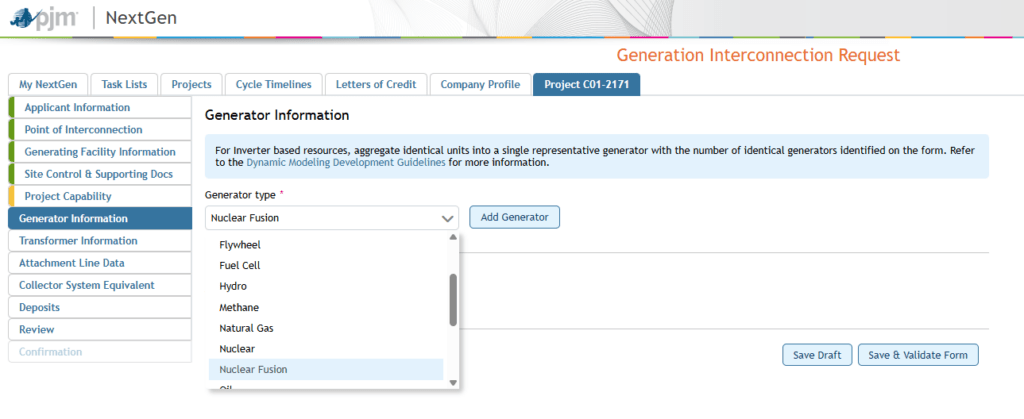
It’s also important to acknowledge the professionals at PJM. There has never been a more challenging time to plan and execute the safe operations of the power grid. PJM demonstrated the willingness to engage early and learn about the characteristics and benefits of clean and firm fusion energy. Their new NextGen application was efficient and user friendly, supported by well documented user guides. A year ago, fusion energy wasn’t in the drop-down menu on the application website. But now it is:
The transition to a clean energy economy is the most urgent challenge of our time, and fusion energy is the ultimate tool to meet that challenge. But building the power plant is only part of the effort; equally critical is ensuring the electricity we generate can seamlessly reach the customers and communities that need it. By applying to interconnect within PJM now, we’re proving that fusion is moving out of the laboratory and into the permitting and planning phases of traditional power generation.
At CFS, we’re building for the future right now. The science is advancing, the magnets are proven, and with this application, our journey on the path to the grid in the early 2030s remains on track.
SPARC®, ARC™, and Fall Line Fusion Power Station™ are trademarks of Commonwealth Fusion Systems®.