New physics papers lay firm foundation for CFS’ ARC fusion power plant design
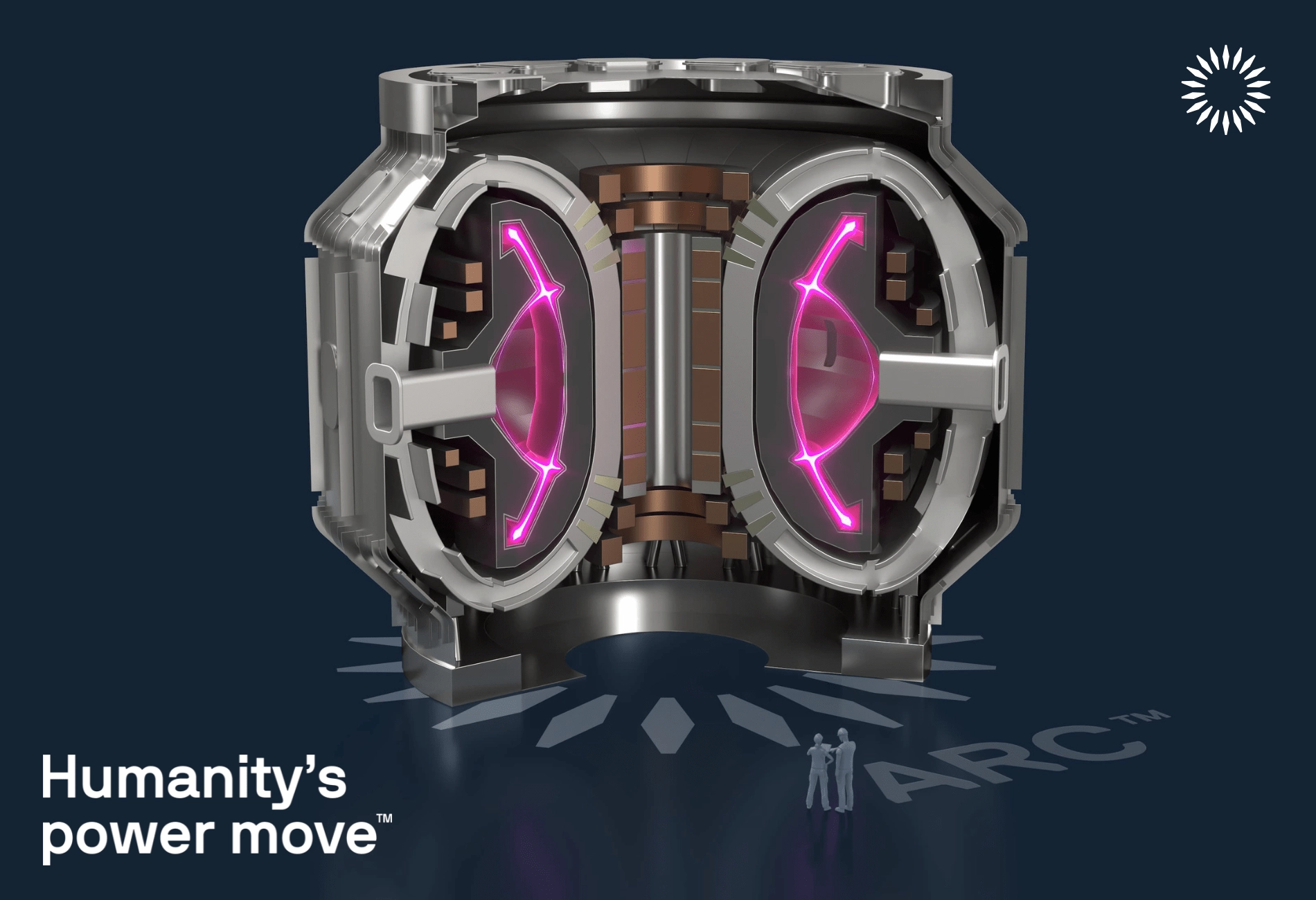
With the publication today of five deeply researched and peer-reviewed papers, Commonwealth Fusion Systems (CFS) and dozens of collaborating physicists have cemented our confidence in the core plasma physics assumptions at work within our upcoming ARC fusion power plant.
Fusion energy, the power source of the sun and other stars, has plenty of challenges here on Earth. We’ll need to control a superhot fusion fuel called a plasma — an intensely dynamic cloud of charged particles. But these papers show how we’ll handle those plasma physics challenges so we can bring this clean, secure, abundant source of energy to the electricity grid — the last form of energy that humanity will need.
The five papers are the culmination of our methodical work to deliver fusion power plants at scale. The papers:
The scientifically rigorous papers, with 58 co-authors, span 226 pages in a special collection of the Journal of Plasma Physics. They detail how an ARC plant will produce roughly 1.1 gigawatts (GW) of fusion power that we’ll convert into 400 megawatts (MW) of net electricity delivered continuously to the grid — enough to power about 280,000 average American homes.
With our physics capabilities now established, CFS has begun devoting more attention to designing and engineering the ARC plant. As with the tokamak’s physics, that effort is an extension of the SPARC project. By design, the two tokamaks are similar so we can transfer what we’ve learned directly from SPARC to its successor. Once SPARC works, we know ARC plants will, too.
These are the five ARC physics basis papers (and keep on reading if you want a detailed look at each):
The papers join a list of CFS achievements since our 2018 founding. Among them: building the world’s strongest superconducting magnet for fusion; designing our SPARC fusion demonstration machine; developing a supply chain of critical components; building and running our magnet factory; beginning SPARC assembly; selecting a site in Virginia for our Fall Line Fusion Power Station; signing on Google as our first commercial customer and Italy-based energy company Eni as another; and applying to connect our ARC plant to PJM Interconnection to make it the first grid-scale fusion power plant in the world.
This record of steady execution, underpinned by our SPARC experience, is the basis for our confidence in our ability to meet our goal of bringing fusion power to the electricity grid at scale as soon as possible.
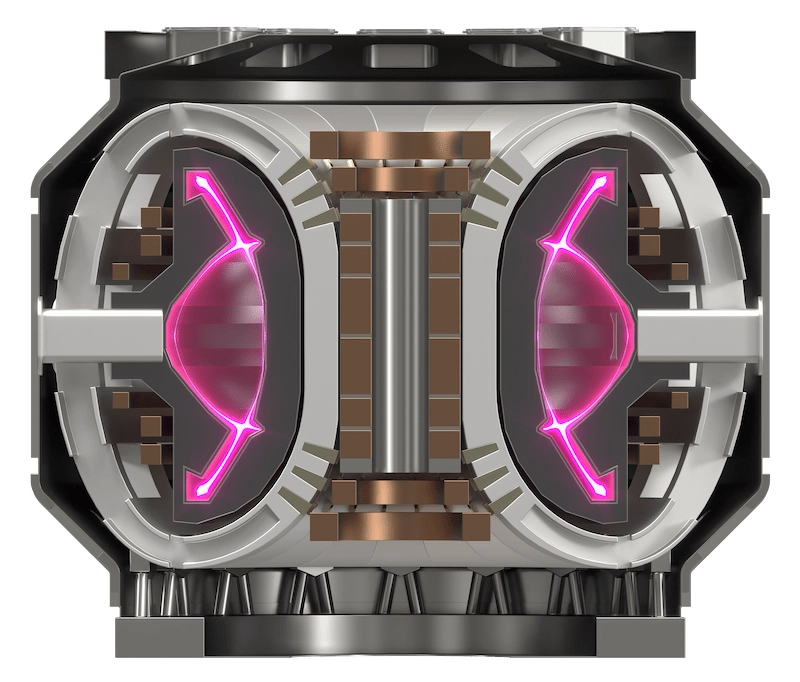
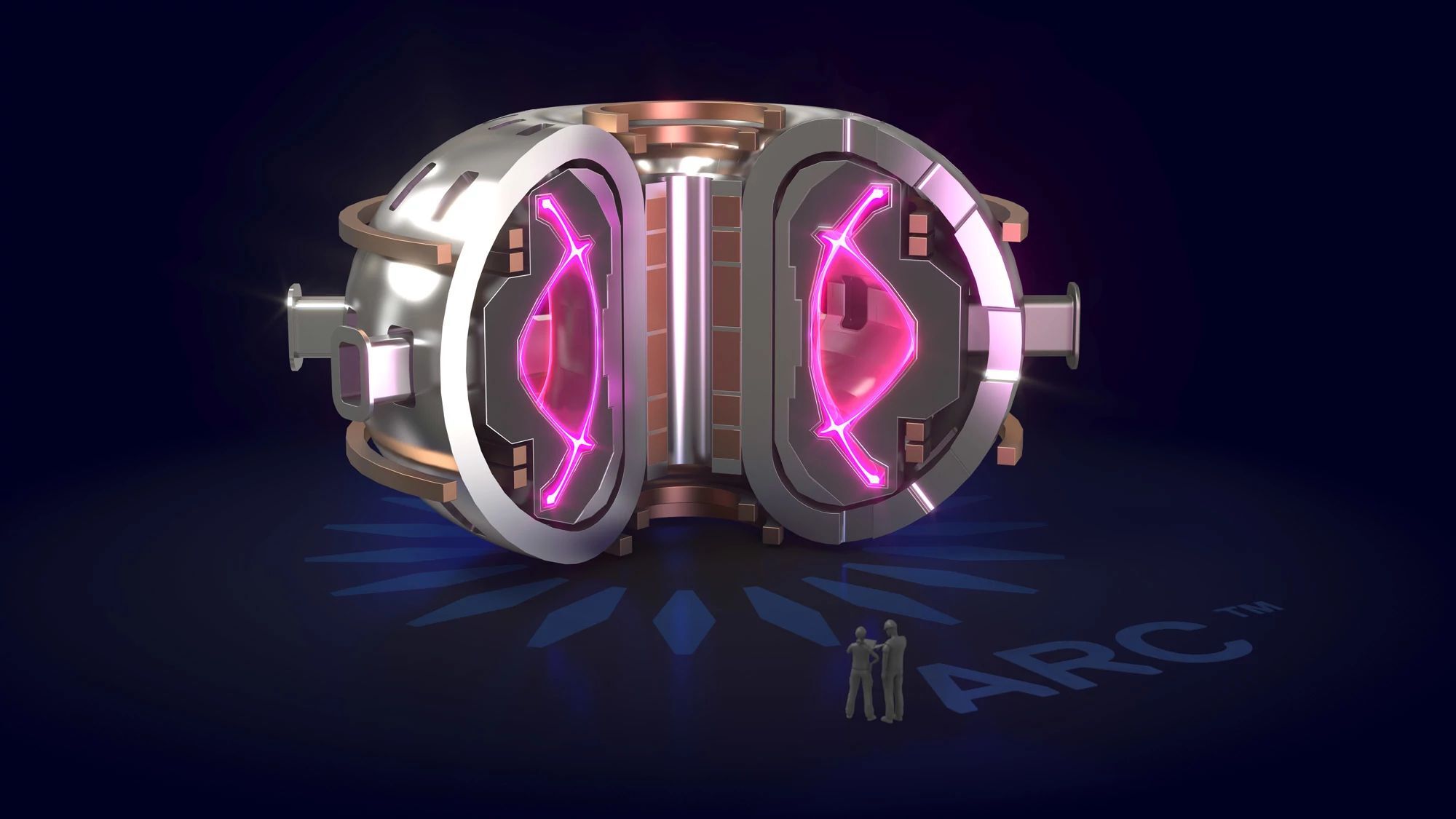
A midplane illustration of Commonwealth Fusion Systems’ ARC tokamak
Four of the papers dig into major aspects of the plasma physics of the ARC plant, detailing the behavior of the plasma itself and ways we’ll handle challenges like exhaust heat and plasma disruptions. The fifth paper offers an overview that combines the other papers’ findings and shows our confidence that we’ll be able to produce more than a gigawatt of fusion power.
Through this process, we’ve shown that the ARC power plant agrees with known physics, that it successfully extends SPARC’s lineage, and that we have the physics tools to further refine the ARC design. Both the SPARC and ARC machines are donut-shaped devices called a tokamak.
“We are laying out, arguably for the first time, a realistic physics design point for a commercially relevant fusion power plant,” said Alex Creely, Chief Engineer of ARC Conceptual Design at CFS and author of an editorial accompanying the ARC physics basis papers. “These papers show why CFS and our partners are confident in the physics underlying the ARC fusion power plant. Designing a fusion power plant that we truly intend to build soon means that we had to ask the right questions, sharpen our tools, and focus on the top priority information that SPARC will teach us.”
We’ll keep using those tools, too. The papers show how we’ve developed a unified simulation framework so we can evaluate the physics of new ARC iterations. With the tools, we can tweak the physics to best match engineering and commercial priorities, advancing ARC’s design to steadily improve the power plant’s performance and economics.
With these papers and the dozens about SPARC that precede it, we and our collaborators are showing our work so you don’t have to just hope our assertions are true.
“We’ll have things to learn on SPARC,” Creely said. “But nothing in the physics is crazy or groundbreaking or needs a leap of faith to believe.”
We’ve walked this path before. Back in 2020, CFS published seven papers on the SPARC physics basis. (The overview paper describing SPARC from that set is currently the Journal of Plasma Physics’ most-read research paper.)
Those earlier papers lay out the detailed physics of SPARC. Similarly, the ARC physics basis papers don’t cover engineering for the most part, but ARC is an extension of the work we’ve already done on SPARC in that domain, but also benefitting from more detailed and more refined physics work.
“The depth of analysis, and the maturity of the models and workflows, are more advanced for ARC than they were for SPARC at a similar point in the project,” said CFS Principal Scientist Jon Hillesheim, lead author of the ARC physics basis overview paper.
The physics basis papers illustrate a CFS tenet for research: Tap into the broad expertise that exists beyond CFS’ campus to make sure we’re on the right track. Peer-reviewed articles, written with collaborating researchers and validated by independent experts, are a key part of that mechanism.
For example, two thirds of the papers’ 58 co-authors are collaborators working elsewhere: the Chalmers University of Technology, the KTH Royal Institute of Technology, the Max Planck Institute for Plasma Physics (IPP), Neural Concept, and the University of California San Diego. Two of the papers’ lead authors are from universities — the Massachusetts Institute of Technology, where CFS’ roots lie, and Columbia University.
The peer review process brings independent scrutiny that ensures we’re not making mistakes like overlooking important factors, bungling our math, or drawing unjustified conclusions. Plasma physics is hard, but peer review helps provide the confidence we and others can have in CFS.
“It reflects well that CFS is so open to both publishing and presenting,” said Phil Snyder, Vice President of Plasma Physics at CFS. “Collaboration makes us stronger, and peer review is the gold standard for validating that ARC is built on a firm foundation that we, and anyone judging CFS, can trust.”
We’re not alone in building this foundation for trust. Other fusion energy companies have published peer-reviewed papers involving commercialization with a variety of fusion machines, including spherical tokamaks, stellarators, magnetic mirrors, inertial confinement, Z-pinch, and field-reverse configuration devices. Peer-reviewed publications are the best way for a company to validate its progress on the six milestones to competitive fusion energy.
Now, here’s that closer look at the ARC physics basis overview and the four companion papers.
The overview paper about the ARC physics basis validates the foundation our company is built on: We can build a compact tokamak that’ll produce enough net energy for a power plant, and we can do it without requiring any breakthroughs or new mechanisms beyond what’s known from decades of international research on tokamak plasma physics. That compact design is fundamental to ARC’s economic attractiveness.
“This collection presents the broadest, deepest set of plasma physics analysis, seriously addressing what it takes to build a commercial power plant,” Hillesheim said. “The papers show that a tokamak power plant based on CFS’ HTS magnet technology results in a much smaller design than many other power plant design studies, and our analysis found no plasma physics showstoppers that such a design would encounter.”
The overview paper details a number of characteristics for a recent ARC design version:
Much of SPARC and ARC are very similar, from their core magnet technology to the way they behave. We understand the tokamak physics well, and SPARC will let us confirm and where needed refine that understanding for the ARC power plants.
Although fusion occurs only in the hottest part of the plasma, the performance of the tokamak is strongly constrained by the need to keep the walls cool. ARC will use two regions called divertors to handle the heat leaving the plasma and to remove the helium produced by fusion from the plasma.
“The real challenge for a next-generation machine like ARC is to manage both of these requirements, the hot core and the cool edge, at the same time,” said Thomas Eich, Divertor and Boundary Operations Lead at CFS and a lead author of the paper detailing ARC’s approach to heat exhaust.
Our divertor design — which has the same features as SPARC’s — is key to ARC’s success. The compact design of ARC, enabled by our high-temperature superconducting magnets, poses a challenge for the divertor: We’ll have less wall area to deal with the power leaving the plasma. ARC addresses this challenge in several ways, each built into SPARC to test before we finalize designs for the last parts of the ARC plant we’ll have to construct:
The power exhaust challenge is a key focus for much of the tokamak research community, and we built SPARC to be able to address it comprehensively to extend the cutting edge of research from current tokamaks all the way to the design of ARC.
A tokamak uses magnetic fields to carefully manage its plasma, confining it to the right position as it’s heated up to fusion conditions. But plasma instabilities can in effect break that magnetic bottle and cause the plasma to rapidly cool down, an event called a disruption. In an ARC plant, a disruption can terminate a 150M°C plasma carrying 12 million amps of electrical current in milliseconds.
A change that dramatic poses several challenges. As the plasma rapidly cools, its heat can melt a thin layer of the interior wall of the tokamak that faces the plasma.
Note that this is just surface melting, not catastrophic breaching of the vessel. Still, the sudden loss of the plasma’s electrical current and associated magnetic field can create powerful mechanical forces in the tokamak’s hardware. And in some situations, the current drop can create a voltage in the plasma that accelerates electrons into a damaging beam.
We’re designing ARC plants to minimize disruptions but also to handle about one a day, rapidly restarting so they don’t interrupt electricity generation. This pragmatic approach sidesteps the potentially Herculean effort that would be required to try to prevent disruptions altogether.
And we’ll be able to validate our approach with SPARC. “On the whole, disruptions do not get more severe as we step up from SPARC to ARC,” said Ryan Sweeney, CFS Manager of Disruption Physics and lead author of the paper about handling disruptions in the ARC plant. “Demonstrating the ARC disruption strategy on SPARC retires a significant amount of the disruption risk for ARC.”
One method for handling disruptions is gas injection. When we detect an imminent disruption, we’ll inject neon and hydrogen gas. It absorbs plasma energy that would be directed at one spot in the tokamak, instead radiating it as ultraviolet and X-ray light in all directions — effectively providing a softer landing during a disruption. This technology has been demonstrated to work on tokamaks including the JET, ASDEX-U, and DIII-D.
During disruptions, the electromagnetic forces on the vacuum vessel that houses the plasma are serious, but the vacuum vessel immediately surrounding the plasma will be designed to handle it. And because the ARC vacuum vessel is replaceable, these forcing events in ARC’s lifetime can be shared among many vacuum vessels.
As for the electrons — a bigger problem with SPARC and ARC than for earlier tokamaks with less electrical current — a special magnet called a runaway electron mitigation coil (REMC) could help scatter them harmlessly. We’ll evaluate that technology in SPARC.
To generate 400 MW of electrical power for the grid, our ARC plants will need to produce a higher level of fusion power. That’ll account for factors like inefficiencies in the steam turbine electricity generation system. By linking several computer models that capture many ARC attributes, we show in a paper about the ARC plant’s performance that it should be able to produce enough fusion power to meet our electricity production targets — the ones we included in our application to connect our first ARC plant to the grid and that our customers have signed up to receive.
“This integrated modeling indicates that ARC is capable of producing approximately 1 gigawatt of fusion power near its current design parameters,” said Nathan Howard, the paper’s lead author and an MIT researcher who collaborated with CFS on the work. “It’s the highest-fidelity modeling ever performed for a fusion power plant, employing about 100 high fidelity supercomputer simulations.”
A gigawatt of fusion power is about 8 times more power than the 140 MW or so that SPARC will produce. But the ARC design’s higher output doesn’t rely on operating in some exotic new regime we don’t know about. Instead, it’s chiefly the result of ARC plant’s larger size. The fusion power per volume is the same in both tokamaks, which is what you’d expect since they share similar characteristics despite their physical size differences.
Simulating a tokamak is no simple task. Physics models must capture phenomena like plasma heating, turbulence, and the transport of particles and heat within the plasma — factors that work against the effort to confine the plasma to help achieve high performance. We integrated these factors and more into a single computing framework that we can use to update our ARC design.
This paper examines in particular the importance of the “pedestal” region of the plasma — the border at the edge of the hot core. Improving plasma performance in this pedestal region will be a powerful influence on how hot we’ll be able to make the plasma core.
Decades ago, fusion scientists created a whole new field of research called magnetohydrodynamics (MHD) that marries two already complicated domains: electromagnetics and fluid dynamics.
In electromagnetism, charged particles respond to electromagnetic forces even as they generate new ones while moving. And fluid dynamics governs complicated behaviors like turbulence. Mix the two and you have a thorny tangle of physical behaviors.
Historically, that’s meant fusion researchers have struggled to predict plasma behavior and struggled to keep their fusion machines’ plasma stable — for example when the expansion forces from the hot plasma’s pressure exceeds the magnetic fields tokamaks use to confine the plasma.
In many magnetically confined plasmas, the issue is the overall stability of the plasma: It can throw itself into the walls or rip itself apart in milliseconds. However, tokamaks aren’t unstable in such dramatic ways. The world has operated tokamaks for decades in stable ways even before the advent of advanced computer controls, and their superior stability is a key advantage over other fusion approaches.
Instead, when we talk about plasma stability in tokamaks, we’re talking about wiggles inside the plasma that degrade the ability to contain the heat. Those wiggles grow relatively slowly, over a period of seconds.
“One type of tokamak instability, so-called neoclassical tearing modes, are complex and therefore hard to model and predict,” said Nils Leuthold, lead author of the paper examining the ARC plant’s magnetohydrodynamics and an associate research scientist at the Columbia Fusion Research Center. These modes create “islands” of disconnected magnetic fields that can grow, undermining plasma confinement and fusion performance and potentially causing disruptions.
But the ARC plant should be able to largely sidestep such instabilities: ARC will operate in a calmer regime that doesn’t require high plasma pressures relative to the magnetic field. And again, we’ll prove it out with SPARC.
“ARC was designed to be stable to these problems, and the modeling supports that,” Nils Leuthold said. “CFS is in the rather unique position of building a smaller version of their ARC power plant — SPARC — which helps to address this issue.”
The five papers form an integrated collection of simulations and calculations that all hold together consistently and pave the way for our next improvements.
The papers are based on a recent ARC plant design called Version 3A that we produced through several iterations to maximize performance while minimizing cost. This isn’t the final picture, since we’re continuing to learn, but it’s a good place to take a snapshot. We’re working on upgraded designs that’ll tweak characteristics like tokamak width or diverter length, but we expect the physics conclusions here will still apply.
By showing where we intend to head, we can help let the broader fusion community know where the interesting areas of investigation lie. This helps spin the flywheel for better and better fusion designs: building on the strong science, condensing that into feasible power plant designs, identifying areas that’ll bring improvements, seeding investigations, developing better science… and so on. That continual progress started decades ago on tokamaks, has continued to today in simulations and experiments, will benefit from SPARC tomorrow, and will continue forever as we make better and better fusion machines.
Those who want to check our work are welcome to dig into the papers and an accompanying package of digital assets to check our work in detail. It’s all in the spirit of transparency core to peer-reviewed research.
“Putting this out there will flag to researchers that we’re really serious not just about the physics but also about ramping up the pace,” Hillsheim said. “Fusion progress sometimes has been slow. But now in the physics community, people are looking at us and realizing we’re really pushing fusion forward.”
SPARC®, ARC™, and Fall Line Fusion Power Station™ are trademarks of Commonwealth Fusion Systems®.